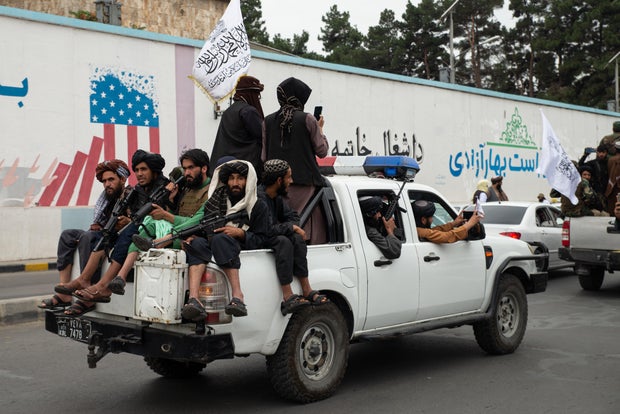
一 | As Massoud walked down a Kabul street one cold Sunday morning, looking for a day job to feed his family, pickup trucks full of armed Taliban members stopped in front of him. He told CBS News the men aimed their AK-47s at him, he was handcuffed, blindfolded and taken to an office of the Taliban's General Directorate of Intelligence.For more than a month, Massoud's family had no idea where he was. They searched everywhere, including hospitals, until they arrived at the Taliban's intelligence department. "After six weeks of searching, they found me at the Taliban's 040 intelligence department," Massoud told CBS News in a phone interview. He said during the first 15 days of his imprisonment, he was "beaten, struck with electric shock sticks, electrocuted, waterboarded and hanged upside down."Taliban members ride in a pickup truck during a celebration of the first anniversary of the Taliban's return to power, August 15, 2022, in Kabul, Afghanistan. Nava Jamshidi/Getty His crime? Massoud worked for the U.S. military as an interpreter from 2011 to 2013, including a year spent working with U.S. Navy SEALs. (CBS News is not using the real name of Massoud or the other former interpreter interviewed for this story to protect them from possible retaliation.)
"Don't want to see that horror again"
Massoud said that during interrogations, Taliban intelligence officers told him that, "with my help, the Americans have killed our people, and that I was still spying for the Americans.""I told them, 'You have announced a general amnesty,'" Massoud told CBS News, but he was informed by the Taliban interrogators, "there is no amnesty for you people."
Massoud was finally released by the Taliban after more than three months of imprisonment, after his brothers signed two separate guarantees promising the Taliban they would bring him back to the intelligence agency if ever asked to do so. CBS News has seen the letters and other documents his family filed with Taliban officials while he was imprisoned."They can find me anytime they wish and put me back in the prison," he told CBS News. "I just don't want to see that horror again."
"Still in danger"
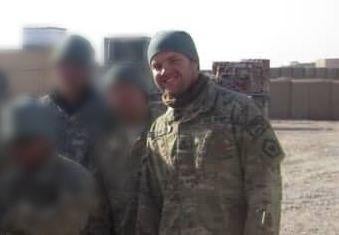
U.S. Army Sgt. Jordan David Johnson, who has since been honorably discharged, was Massoud's direct supervisor in Helmand province and has written to members of the U.S. Congress supporting his former Afghan colleague's application for a U.S. visa, but to no avail. "Every time I hear from Massoud I feel guilty, because he is still in danger," Johnson told CBS News. "We told them that, 'You help us, and we will help you.' But now we are not, and that is wrong."U.S. Army Sgt. Jordan David Johnson (right), who has since been honorably discharged, is seen during his deployment in Afghanistan's Helmand province, with his Afghan interpreter Massoud (top left) and others. Photo courtesy of Jordan David Johnson In a September 2022 letter to lawmakers, Johnson said he trusted Massoud then, "and I am proud to call him a friend today," adding that he did not believe the Afghan "poses a national security threat to the United States of America."
"They will come after me and my family"
Omar, 32, told CBS News that he worked with the U.S. military from 2008 until 2012 and was deployed alongside U.S. troops in eastern Paktia province. From 2012 until Afghanistan fell back into the Taliban's hands in August 2021, he worked on various projects with the U.S. Agency for International Development (USAID) at the U.S. Embassy in Kabul. He was threatened many times for working with the U.S. and was injured in what he believes was an assassination attempt in 2014, after he filed for a U.S. visa.
Afghan women who served with Americans fight for U.S. residency 2 years after Taliban takeover03:05Despite the threats, which he continued reporting to his supervisors at the embassy, Omar was informed that his U.S. Special Immigration Visa, or SIV, application had been rejected because documents he submitted previously had been deemed fraudulent. He believes it's because he failed a polygraph administered by U.S. officials eight years earlier, and that the process was unfair. "They intentionally make you a criminal," he told CBS News. "You are only allowed to answer their questions with yes and no, and they don't give you a chance to explain." Omar filed an appeal against the rejection of his application in mid-June and is waiting for a response. He urged the U.S. government to "seriously look into our cases and take us into safety," adding that if it doesn't happen, "they will come after me and my family one day."
"Absurd that it takes so long"
During the 20-year war that followed the 2001 U.S.-led invasion of Afghanistan, thousands of Afghans served as interpreters and translators, working shoulder to shoulder with U.S. troops and diplomats, risking their lives serving on the battlefield and communicating with locals.
These interpreters were essential to bridge the language barrier, but also to provide cultural context, gather intelligence, negotiate with tribal elders and build trust with local communities. Massoud and Omar both applied for SIVs under a program created by the U.S. Congress in 2006 to offer legal pathways to the United States for Iraqis and Afghans who helped during the U.S. military operations in those countries. But the bureaucracy of the SIV application process has left many applicants frustrated, with little faith in the program.Massoud said his application was rejected due to a lack of documentation from his supervisors, despite Johnson trying to help. He said he submitted the requested documents and has waited for more than 320 days with no update from the U.S. government. "Every time Massoud submits all his documents and we think, 'now we are waiting for his visa to be approved,' then Massoud would contact me again saying, 'I need this and this document, because they keep changing the requirements,'" Johnson said.
The backlog, and work to improve a "vital program"
"We have surged resources to this vital program, significantly increasing the number of staff dedicated to it. We have reviewed every stage of the multiple step application process to streamline it wherever possible, consistent with U.S. law, and continue to look for areas to improve," a State Department spokesperson told CBS News.The official said the steps had enabled the State Department to issue "nearly 34,000 SIVs to principal applicants and their eligible family members" from the beginning of the Biden administration until August 1, 2023.
As of the end of March, State Department figures show about 9,800 principal SIV applicants had cleared a major hurdle in the process, securing Chief Of Mission (COM) approval. Those individuals are "awaiting further processing and their eventual visa interview before being issued an SIV," the spokesperson said, adding: "We are working to process these cases as quickly as possible."The State Department's figures show that another 69,000 principal applicants were undergoing the review process, and the spokesperson told CBS News that, historically, about half of the applications who reach that stage of the process do not end up qualifying for an SIV.According to the figures, 3,241 Afghan applicants were "deemed unqualified to receive COM approval or had the approval revoked during the second quarter" of 2023."The Department will continue to ensure Afghan SIV applications are processed as quickly as possible in accordance with the statutorily required program parameters and national security requirements," the spokesman told CBS News. A report issued this week by a State Department inspector general said, meanwhile, that according to the department's own estimation, as of April 2023, a total of "more than 840,000 principal and derivative SIV applicants remained in Afghanistan."CBS News' Tucker Reals and Paulina Smolinski contributed to this report.